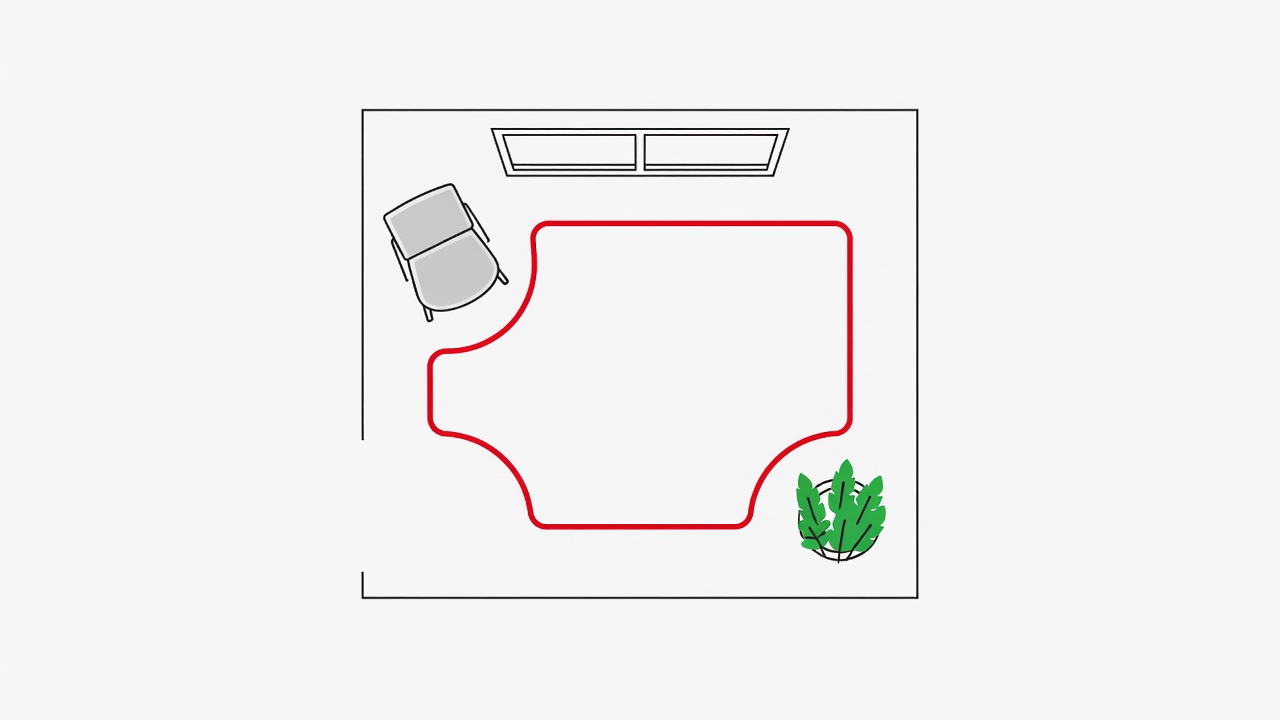
Draw what cannot move
Sketch the room with doors, windows, radiators, sockets and any fixed storage. Add the furniture that must stay. This does not need to be a polished floor plan; a rough drawing with reliable measurements is more useful than a beautiful mood board that ignores an opening door. Include the space occupied by curtains, chair movement and accessible routes.
Next, mark where daylight reaches the proposed plant positions. Observe rather than assume. An open-plan room can contain several very different growing conditions, and the visually empty corner is not automatically the best place for living foliage. Separate the room’s needs from the plant’s needs so you can see where they genuinely overlap.
Give the corner a job
A convincing arrangement supports something people already do: reading, arriving home, sharing a meal or looking out of a window. Choose that job before placing decorative elements. In a reading corner, the chair and useful lamp come first. In an entry area, door clearance and a place to set down essentials matter more than creating a dense canopy.
Choose one plant position that does not interfere with that purpose. A broad specimen can sit beside a chair if its mature leaves leave enough clearance. A narrow upright form might work better beside a cabinet, subject to suitable light. Avoid putting plants on every available surface; the table still needs room for the objects used there each day.
Build an anchor and a supporting layer
Start with the largest visual element: perhaps a comfortable chair or an established floor plant. Add a smaller supporting element at a different height, then pause. A low cabinet, a stable stand or a modest wall grouping can create the next step. The composition needs a relationship between shapes, not a fixed number of pots.
Repeat one material across the arrangement. A timber stand might connect to the chair legs, while a dark frame echoes the pot. Leave an area of plain wall around the foliage so the outline reads clearly. If the room already contains many patterns, simplify the backdrop rather than trying to compete with it through more dramatic leaves.
Arrangement note: a compact lounge
Keep the existing sofa and side table. Place one suitable floor plant near the window without blocking the curtain. Add a small botanical print above the side table and repeat the frame finish in the pot. The print extends the theme without taking up another floor position.
Adapt the route to your home
In a rental, favor reversible moves: a freestanding stand, a protected container and artwork displayed in a permitted way. Ask before drilling or altering surfaces. Do not assume a tension fitting, adhesive hook or leaning frame is safe for every wall or household. Stability matters particularly around children and animals.
In a larger room, resist filling the perimeter evenly. One strong cluster and a smaller visual echo elsewhere can feel more coherent than a plant in every corner. A botanical print, repeated timber finish or matching container can make that connection. Living greenery does not have to carry the whole theme, especially where the secondary position lacks suitable light.
Arrangement note: dining space with limited floor area
Protect chair movement first. If a suitable plant position exists beside a low cabinet, keep the arrangement there rather than placing a large pot behind a pulled-out dining chair. Use wall art to connect the dining table to the botanical corner without occupying the table itself.
Rehearse daily life before finishing
Walk through with laundry, open storage doors, sit in every seat and reach the window controls. Check whether you can water and inspect each plant without lifting it over furniture or electronics. Move a temporary object into the proposed footprint before committing to a heavy planter. Keep exits and required circulation routes clear; decorative advice does not override accessibility or fire-safety requirements.
Live with the first arrangement before adding more. Notice whether a leaf catches your sleeve, a stand makes cleaning difficult or a pot blocks useful light. Adjust the layout for those observations. A styled room should improve everyday use, not ask everyone to tiptoe around a composition. Once the corner works, let it remain slightly unfinished: room for growth is part of the design.